Friday, March 21, 2008

The Lord's Passion: Good Friday

Today's sermon is by The Most Rev. Theresa Margaret Wilson, Bishop of Colorado and founding director of the Benedictine Order of St. Michael the Archangel. Bisohp Wilson is also the Rector of Good Shepherd of the Hills Church in Pueblo, Colorado.

Perhaps one of the most paradoxical thoughts in all of Christendom is that of how Our Lord’s death and passion on a Roman cross is powerful, glorious and victorious. In our humanness we would think that such a death would be a sign of extreme weakness – the Lord having not said a word in His own defense – and certainly anything but glorious and victorious.

For those of us who have followed Our Lord for many years, this day of the church year is most significant in its glory and victory. We know from our studies and our own personal experiences in life that the cross has brought great glory into our lives and certainly given us victory over sin and death.

When the Lord stretched His hands out that day, He drew all men to Him and the veil in the temple was torn, the Holy of Holies left open, prophecy fulfilled, and the law gave way to the gospel. His cross is the source of every blessing and grace in our lives.

As we celebrate Good Friday in Pueblo, we will be taking a walk through the Stations of the Cross. There are many good meditations to use for this service and I trust that each one of you will either find a service to attend and/or use a meditation of your own in your own space to dwell upon this glorious time in history.

The cross of Christ is a sign not of death but of the good news – the gospel – of life, hope, serenity, and the guarantee of eternal life. Today let us celebrate this means of our salvation. It has been the source of countless blessings; it has shone on us when we were in darkness. It reconciles us with God. How glorious! How victorious!

Read John’s account of the passion (John 18:1-19:42) and experience the depth of this mysterious time.

May God’s richest blessings be upon you and yours during this glorious Easter season.

Thursday, March 20, 2008

In Remembrance of Me: Maundy Thursday

Today's sermon is by The Rev. Thomas Squiers of the Diocese of Texas. Father Squiers is Vicar General of the Diocese and also serves as an Oblate in the Benedictine Order of St. Michael the Archangel.


Today is the fifth day of Passion Week or Holy Week, known as Maundy Thursday. The word 'maundy' comes from the Latin mandatum, or mandate. The word mandate is defined as to order or to require (the root word of mandatory).

There are several elements that take place on this day in the Scriptures in the final moments in the life of our Savior. These moments are acted out in our worship services. The most important act is that of his instituting the sacrament of the Holy Eucharist.

Jesus had gathered with his followers for one last time prior to the crucifixion in a place called the upper room, which was more like a loft. They shared a meal together. When they finished their meal, Jesus took a piece of bread and said to them, metaphorically, that "This is my body given for you, when you eat of it, remember me." Then he took a cup of wine and said similar words "This is my blood given for you, when drink this, remember me."

Can you imagine what it was like sitting there listening to those words? Can you imagine the confusion of His followers trying to grasp what the Master was saying? When we celebrate the Holy Eucharist, we present the bread and the wine as "gifts," as we say "Here, O Lord, we present these gifts of bread and wine..." The bread and the wine are indeed gifts. They are gifts of God for the people of God. The Sacrament represents Christ, broken through the Crucifixion, sacrificed for all of humanity yet given freely for our redemption.

Remember Me. We are called to remember that which Christ bestowed upon us, an act of God's grace, the outward and visible sign which we take unto ourselves so that we may...remember.

After the Eucharist on Maundy Thursday, the Altar is stripped of the linens and everything is removed from the chancel. The candles are extinguished and removed, including the sanctuary lamp. The light is gone as are the appointments. What we are left with is an empty apse. The moment is intense for we know what happens next. This sets the stage for Gethsemane and Golgotha.

As we celebrate Maundy Thursday, let us remember this is the day that Christ gave us elements of bread and wine for a purpose. It is through the Holy Sacrament that we are called to partake in the full ministry of Christ, as believers, as followers. It is in this bread and this wine, this body and this blood that we are restored, healed and delivered.

Let us pray:
Almighty Father, whose dear Son, on the night before he suffered, instituted the Sacrament of his Body and Blood: Mercifully grant that we may receive it thankfully in remembrance of Jesus Christ our Lord, who in these holy mysteries gives us a pledge of eternal life; and who now lives and reigns with you and the Holy Spirit, one God, for ever and ever. Amen.

Sunday, March 16, 2008

The Sunday of the Passion: Palm Sunday

This Sunday's sermon is by The Rev. Barbara Dyke, a United Methodist minister in San Angelo, Texas, who is part of Ecumenical Relations with the Diocese of Texas. "Pastor Barbara" serves as the minister of First United Methodist Church of Mertzon.


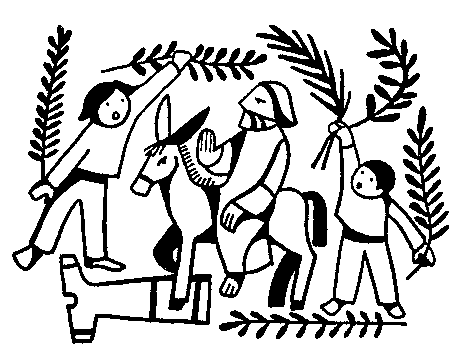
Palm Sunday is a moment of triumph as we read about Jesus entering the city of Jerusalem. But why is it triumphant?

It was a triumph for us today because Jesus was faithful to his Heavenly Father. Jesus understood the big picture at what was at stake when he rode into Jerusalem. Jesus knew that it was more important to satisfy God’s will than the crowd’s desire.
The crowds cheered for a Messiah that would free them from the oppression of the Roman Empire. They wanted someone that would solve all their problems. They wanted a miracle.

For Jesus Palm Sunday was just another temptation. The crowds offered a different possibility than what God had planned for Jesus. Just think how easy it would have been for Jesus to get caught up in the crowd’s desires. He had the popularity and enough followers; he could have organized a revolt against the Romans and may have even been successful. He could have followed the cheers and sought his own glory that was offered by the crowd that yelled Hosanna, Hosanna in the highest.

Fortunately for us, Jesus held fast to the way of the cross. The cross was not what the crowd wanted. If Jesus had gone for fame and glory there would be no Maundy Thursday, or Good Friday, or Easter Sunday.

Jesus followed God’s plan. It was not the popular plan; no body was looking to have their sins forgiven. No body wanted life eternal; they wanted to be freed from the immediate slavery to Roman and nothing else. That is the trouble with mans vision vs. God’s plan. We always want immediate solutions. We are not all that concerned with life eternal. We can not see the big picture. We only see what seems to be in front of us at the moment. We think we have all the answers yet we see very little of what God has in store for us.

Fortunately for us, Jesus saw the whole picture when everyone around him seemed to be looking at the wrong map. Jesus saw the map to the cross while the crowd was looking at a map that had no future.

Jesus entered Jerusalem knowing that he would die on a cross. Jesus knew he would lay down his life so that you and I today might be freed from the slavery of sin and death.

So whose plans are we follow today? We have heard the answer many times. Our light, our map is the same yesterday, today and tomorrow. The answer is Jesus. Jesus is God’s light into the world. Jesus laid down his life for us so that we might have eternal life, free from sin and death. We can rest in the assurance that God is with us and there is nothing that can separate us from our Heavenly Father. Jesus knew that, and was able to stand up against temptation; he was able to ride into Jerusalem toward a cross.